Big Brother is watching and scheming and up to no goodâand, writes security technologist Schneier, it looks like heâs winning.
What The Reviewers Say
Hannah Kuchler,
The Financial Times
The early architects of the internet did not want it to kill anybody. In cyber security expert Bruce Schneier’s new book, David Clark, a professor at the Massachusetts Institute of Technology, recalls their philosophy: 'It is not that we didn’t think about security. We knew that there were untrustworthy people out there, and we thought we could exclude them'. Schneier describes how the internet, developed as a gated community, is now a battleground where these untrustworthy people cause great harm: harnessing computers to kill by crashing cars, disabling power plants and perhaps, soon enough, using bioprinters to cause epidemics.
Steve Donoghue,
Open Letter Reviews
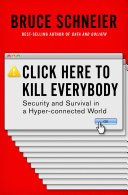
Electronic security expert Bruce Schneier’s studiously terrifying new book Click Here To Kill Everybody: Security and Survival in a Hyper-connected World, is a concerted counter-playbook to the end of human civilization, and the deaf ears it will fall upon have been deadened by two completely erroneous assumptions: that an unregulated Internet is better than a regulated one, and that Internet problems only affect people on the Internet.
Publishers Weekly
Schneier, a fellow at the Berkman Center for Internet and Society at Harvard University, provides a clear perspective on the threat posed by the evolution of the internet into what is commonly referred to as the 'internet of things.' As 'everything is becoming a computer... on the Internet,' with even pedestrian items such as light bulbs or refrigerators collecting, using, and communicating data, the convenience and efficiency of such 'smart' technology comes at the cost of increased vulnerability to the schemes of crafty hackers. Horror stories, such as a vehicle’s controls being taken over remotely, are not new, but Schneier’s vast experience enables him to tie together many strands and put them in context.
Kirkus
By way of an opening gambit, the author posits three scenarios in which hackers take over machines and computer systems, from printers to power plants, both to demonstrate their ability to do so and to show how the interdependence of the web can easily be put to work against us. In one of those scenarios, real-world to the core, Russian hackers came into a Ukrainian power plant through a malware backdoor, 'then remotely took control of the center’s computers and turned the power off.' That’s not just a threat to life, but it also erodes trust in social and economic systems, the basis for civil society.




 29
29