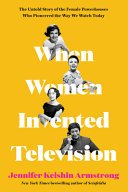
The author of Seinfeldia: How a Show About Nothing Changed Everything returns with a look back at the early days of television and how four groundbreaking women carved their own paths and set the standard for how people watch TV today.
What The Reviewers Say
Nell Beram,
Shelf Awareness
The pioneering-women-rescued-from-obscurity literary subgenre is beautifully served by the authoritative and absorbing When Women Invented Television. Like all of Armstrong's books, it goes down like good TV: although it can be consumed without too much effort, its insights are likely to live on in the reader's memory in something not unlike syndication..
Gwen Ihnat,
The A.V. Club
Armstrong uses her impressive analytic and research skills to unearth some much less-explored ground.
Emma McAleavy,
The Boston Globe
Though meticulous in cataloging their intersecting identities, [Armstrong] returns repeatedly to their shared gender. As a framing device, this can feel slightly at odds with very deep and detailed accounts of disparate treatment and outcomes for each of them. The question of how to think about women as a group with a shared identity is nothing new. Scott herself was inspired by Betty Friedan’s The Feminine Mystique but 'felt trapped between the civil rights movement and the nascent feminist movement.' Armstrong finds herself in a similarly awkward position at times. Though she doesn’t always handle the juxtapositions perfectly, Armstrong successfully crafts an intersectional feminist history, one with room for four very different women in it. Armstrong succeeds in her goal of dusting off these women’s contributions and restoring them to their place in the pantheon of television giants. In prose as charming as the women she writes about, she makes her subjects feel knowable. Although we may never see some of these women’s work (television was often live and unrecorded in the early years), Armstrong makes you feel their genius and charisma, almost like you were there when they invented television..
Michael magras,
The Star Tribune
The book's strongest parts describe the challenges the women faced.