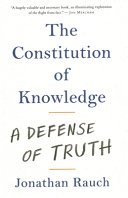
Disinformation. Trolling. Conspiracies. Social media pile-ons. Campus intolerance. On the surface, these recent additions to our daily vocabulary appear to have little in common. But together, they are driving an epistemic crisis: a multi-front challenge to America's ability to distinguish fact from fiction and elevate truth above falsehood. In The Constitution of Knowledge, Jonathan Rauch reaches back to the parallel eighteenth-century developments of liberal democracy and science to explain what he calls the "Constitution of Knowledge"--our social system for turning disagreement into truth. By explicating the Constitution of Knowledge and probing the war on reality, Rauch arms defenders of truth with a clearer understanding of what they must protect, why they must do--and how they can do it.
What The Reviewers Say
Robert G. Kaiser,
The Washington Post
[Rauch] sees clearly what a mess we have on our hands, but he also sees something much more hopeful: a centuries-old tradition of embracing the scientific method.
Emily Bazelon,
The New York Times
Rauch’s subject, in The Constitution of Knowledge, is the building of human understanding. He takes us on a historical tour of how a range of thinkers (Socrates, Hobbes, Rousseau, Montaigne, Locke, Mill, Hume, Popper) sought truth, came to embrace uncertainty, learned to test hypotheses and created scientific communities.
Kirkus
Rauch spares neither right- nor left-leaning activists in his latest salvo in America’s information wars.




 53