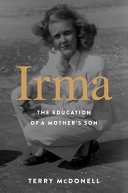
A son's lessons from his single mother--a twenty five year old widow who took control of her life, defied expectations and raised him into a manhood of his own.
What The Reviewers Say
Alex Beth,
Esquire
How McDonell came to understand this brand of masculinity is the subject of his lyrical and self-lacerating new memoir.
Alexandra Jacobs,
The New York Times Book Review
In an afterword, McDonell says that the book was originally 'going to be about me' — and it really still is, though you can feel him continually trying to steer it back to Irma, like a car that’s out of alignment.
Will Hearst,
Alta
I don’t know of anything else like it. Perhaps in empathy for a powerful female figure, it recalls Jim Harrison’s Dalva. My guess is that McDonell’s book became a voyage of discovery of his mother, but also a chance to unravel his own origins and impulses, a rethinking of his own life events, from the changed viewpoint, the inevitable greater perspective, that comes with age.
Adrienne Westenfeld,
Esquire
In this poignant memoir, a former Esquire editor-in-chief memorializes his mother, the inimitable woman who taught him how to be a man. After the death of McDonell’s father, a WWII fighter pilot, 25-year-old schoolteacher Irma was left to raise her young son alone. She made a new life for them in California, where she raised her son to read widely, love nature, and cultivate independence. This accounts for just Part One of McDonell’s memoir; in Part Two, he makes a bold narrative leap, transitioning to the third-person perspective as he recounts his adult struggles and successes, as well as the challenge of cultivating his own 'philosophy of fatherhood' without a role model. Lyrical and lucid, Irma tells a stirring tale of how our parents shape us—the ones who aren’t there, and the ones who are..




 7
7 60
60