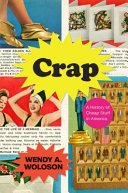
In Crap: A History of Cheap Stuff in America, Wendy A. Woloson takes seriously the history of objects that are often cynically-made and easy to dismiss: things not made to last; things we don't really need; things we often don't even really want. Woloson does not mock these ordinary, everyday possessions but seeks to understand them as a way to understand aspects of ourselves, socially, culturally, and economically: Why do we--as individuals and as a culture--possess these things? Where do they come from? Why do we want them? And what is the true cost of owning them?
What The Reviewers Say
Joseph Barbato,
New York Journal of Books
While great fun, [Woloson's] book is a serious, lively, and brightly illustrated account of cheap commodities and how they have been marketed, sold, and consumed.
Dmitry Samarov,
Chicago Reader
In Crap: A History of Cheap Stuff in America (University of Chicago Press), Wendy Woloson’s heavily researched book devoted to the many objects and ideas under that moniker, she does her level best to find a definition but doesn’t quite nail it down. But it’s not for lack of trying. Crap, it turns out, is an elusive target. In broad terms—as her subtitle indicates—the book is a history of cheap stuff in America ...Woloson makes some compelling discoveries and connections, especially where etymology is concerned.
N. J. Stallard,
The Times Literary Supplement (UK)
Woloson’s book is a history of buying 'crap' – Magic Wand hand mixers, Beanie Babies, knock-off Staffordshire figurines, devices to measure the freshness of eggs (The Eggs Ray), hair in a can, Thighmasters, Baconizers – as well as a dossier of marketing ploys including one of the most fundamental of all: the 'allure of infinite variety', or the art of heterogeny.
Megan Volpert,
PopMatters
Wendy A. Woloson is the kind of history professor who makes a subject come alive.




 5
5 67
67