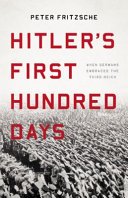
Amid the ravages of economic depression, Germans in the early 1930s were pulled to political extremes both left and right. Then, in the spring of 1933, Germany turned itself inside out, from a deeply divided republic into a one-party dictatorship. Fritzsche examines the events of the periodâ the elections and mass arrests, the bonfires and gunfire, the patriotic rallies and anti-Jewish boycottsâto understand both the terrifying power the National Socialists exerted over ordinary Germans and the powerful appeal of the new era they promised.
What The Reviewers Say
Nicholas Stargardt,
The New York Times Book Review
Fritzsche’s 101 days certainly capture the scale of the upheaval and a swiftly coalescing sense of where the new Germany was headed.
Jennifer Szalai,
The New York Times
Fritzsche describes an era that has been covered by other books—not least his own—many times over. As an esteemed historian of how ordinary Germans accommodated themselves to the Nazi regime, Fritzsche is neither revising his scholarship nor breaking new ground here. But there’s something particularly clarifying about the hundred-days framing, especially as it’s presented in this elegant and sobering book, which shows how an unimaginable political transformation can happen astonishingly quickly..
Andrew Stuttaford,
The Wall Street Journal
In some perceptive passages in the earlier stages of this book, Mr. Fritzsche examines how, during the party’s years in opposition, the Nazis were able to broaden their support away from the original ideological core to voters who, for example, just thought that 'something' had to be done to sort out a deeply unsettled country. And Mr. Fritzsche looks particularly closely at those who swung behind the party in early 1933.
Tom Nuttall,
Air Mail
Fritzsche opens his book with a gripping fly-on-the-wall account of the meeting in which the Make Germany Great Again conservatives, who had the ear of Paul von Hindenburg, the ailing president, decided to make Adolf Hitler chancellor.