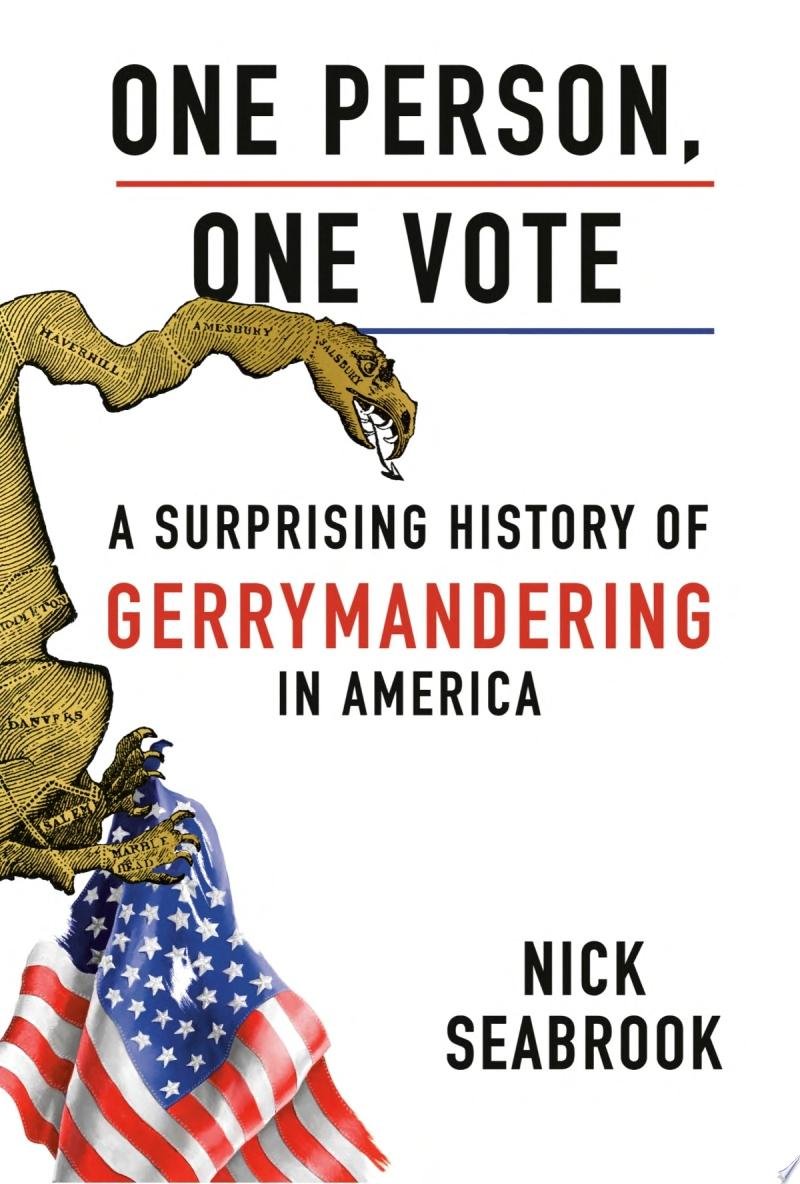
A redistricting crisis is now upon us. This book tells the history of how we got to this momentâfrom the Founding Fathers to todayâs high-tech manipulation of election districtsâand shows us as well how to protect our most sacred, hard-fought principle of one person, one vote.
What The Reviewers Say
Penelope J. M. Klein,
Library Journal
Seabrook’s excellent and cogent account of election boundary manipulation proves that political power knows few bounds and explains gerrymandering’s history and effects and ways to combat it...Seabrook finds similar manipulations in England’s rotten boroughs and describes how the Founding Fathers themselves were not averse to some boundary manipulation...Seabrook concludes that power lies with the people and explains how some states, led by California, are creating independent election district commissions to defeat political machinations...A timely and powerful book that should be read by everyone interested in preserving American democracy..
Roger Bishop,
BookPage
We learn in fascinating and depressing detail from Nick Seabrook’s wide-ranging history, One Person, One Vote, when politicians intentionally draw boundaries for partisan advantage, politicians pick their voters rather than voters picking politicians...Those who benefit from gerrymandering are determined not to lose their advantage...Even the Supreme Court has failed to address the harms of the practice...On three separate occasions, challenges to the most pervasive partisan gerrymanders of the 21st century have come before the Supreme Court, but reformers came away disappointed. Instead, change has almost always come from concerned citizens who convinced elected officials to take on the issue...Seabrook’s important book should be of interest to every citizen who wants to better understand what goes on behind the scenes as political parties seek power..
Stuart Miller,
Los Angeles Times
One Person, One Vote argues that many of America's problems stem from one eternally timely issue...Gerrymandering involves the redrawing of congressional, state and local districts for political gain...It's done by both sides and has often been used to sideline minority representation, especially in the aftermath of the 1965 Voting Rights Act that removed obstacles that had long prevented Black people from voting in the South...Seabrook's title refers to a series of 1960s Supreme Court decisions that required every district to contain roughly the same number of people...But it's also an ironic title because the increasingly sophisticated process works around that requirement, stretching and squeezing districts to predetermine outcomes and making votes count for less and less...Seabrook makes clear that practical solutions exist but achievable ones are in short supply..
Barton Swaim,
The Wall Street Journal
Seabrook has written One Person, One Vote: A Surprising History of Gerrymandering in America chiefly to contend that Democrats in the 2020s are losing elections they would win if it weren’t for Republicans’ skill at electoral topiary. He doesn’t put it as directly as that. He insists that the effort to curb gerrymandering is a matter of 'democratic best practices' and 'good government reform that protects the interests of all citizens.' And he acknowledges that Democrats gerrymander their opponents, too, or at least that they used to do it more effectively than they do now.