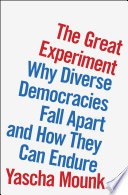
Some democracies are highly homogeneous. Others have long maintained a brutal racial or religious hierarchy, with some groups dominating and exploiting others. Never in history has a democracy succeeded in being both diverse and equal, treating members of many different ethnic or religious groups fairly. And yet achieving that goal is now central to the democratic project in countries around the world. It is, Yascha Mounk argues, the greatest experiment of our time.
What The Reviewers Say
Lee Drutman,
The Washington Post
This vision of progress juxtaposes oddly with the first part of the book, which describes how previous attempts at diverse democracy all apparently devolved into petty and violent wreckage.
Houman Barekat,
The Guardian (UK)
The Great Experiment promises to show us 'how to make diverse democracies work', but contains very few actual policy proposals. For the most part it’s a mishmash of general principles, political truisms and syrupy platitudes, delivered in a register somewhere between a TED talk and an undergraduate dissertation. Mounk draws on social psychology to tell us what we already know.
Joe Klein,
The New York Times Book Review
... [an] academic treatise that may actually have influence in the arena of practical politics.
Ian Beacock,
The New Republic
Mounk is right that the stakes are high and that the future of this project is uncertain. It’s unfortunate, then, that The Great Experiment offers so little meaningful guidance or new insight. Pious and relentlessly superficial, this is a book motivated by feelings more than facts, grounded in single anecdotes, and positioned against a blurry sense of the discourse rather than specific claims or critics or events. This doesn’t make for a very persuasive intellectual intervention, though it’s a killer psychological one. Mounk flatters his liberal readers that it’s now unfashionable and even brave to believe publicly in multicultural democracy—and that by expressing their distaste for cancel culture or 'woke' politics, they have become diverse democracy’s most gallant defenders. But is it? And are they?.




 18
18 90
90