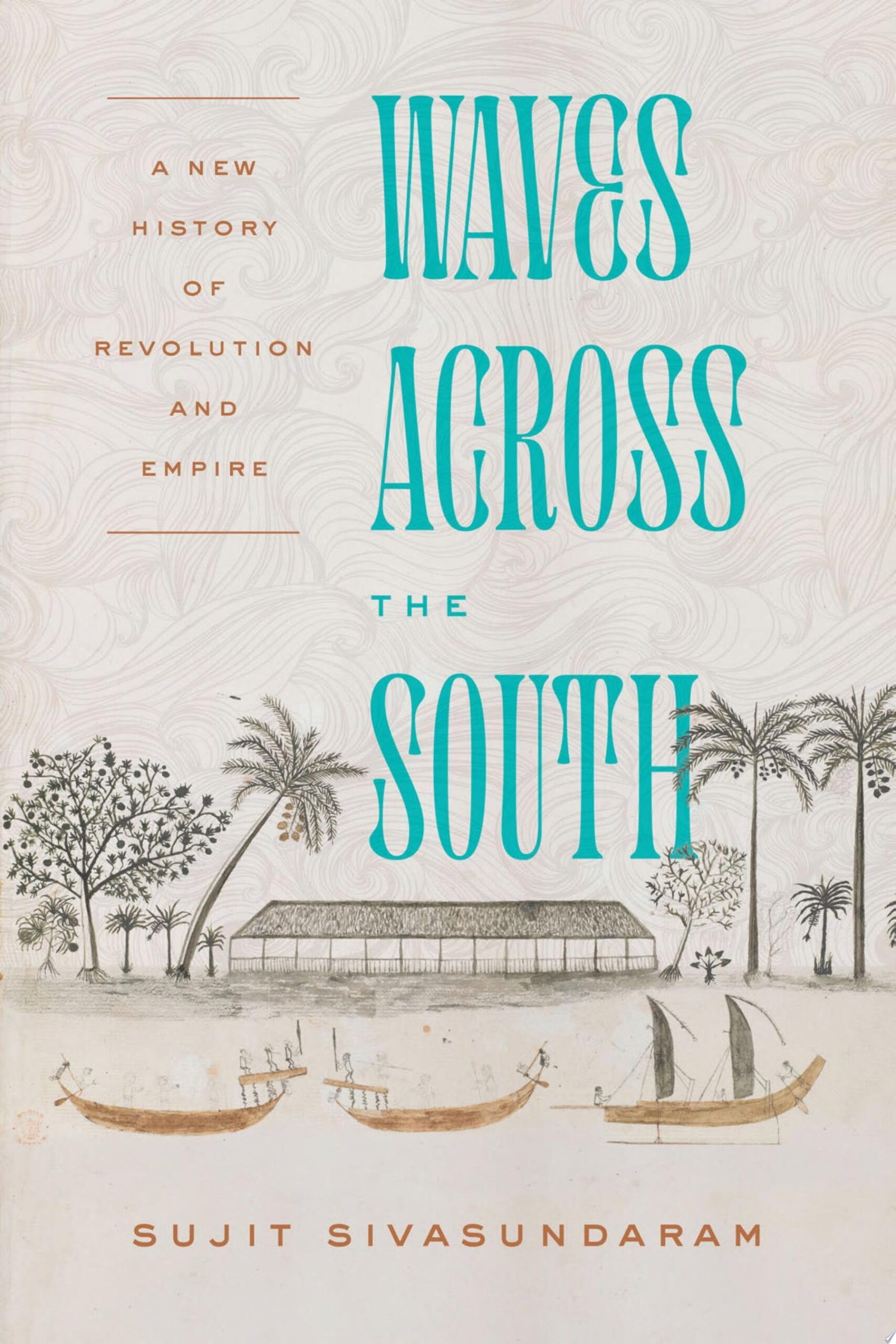
This is a story of tides and coastlines, winds and waves, islands and beaches. It is also a retelling of indigenous creativity, agency, and resistance in the face of unprecedented globalization and violence. Waves Across the South shifts the narrative of the Age of Revolutions and the origins of the British Empire; it foregrounds a vast southern zone that ranges from the Arabian Sea and southwest Indian Ocean across to the Bay of Bengal, and onward to the South Pacific and the Tasman Sea. As the empires of the Dutch, French, and especially the British reached across these regions, they faced a surge of revolutionary sentiment. Long-standing venerable Eurasian empires, established patterns of trade and commerce, and indigenous practice also served as a context for this transformative era. In addition to bringing long-ignored people and events to the fore, Sujit Sivasundaram opens the door to new and necessary conversations about environmental history, the consequences of historical violence, the legacies of empire, the extraction of resources, and the indigenous futures that Western imperialism cut short.
What The Reviewers Say
David Armitage,
The Times Literary Supplement (UK)
Sujit Sivasundaram confidently surfs a dynamic wave of scholarship that has transformed the histories of the Indian Ocean and the South Pacific by looking from below – through the eyes of Indigenous peoples, the enslaved, the subjected and the global South, instead of those of the colonizers, the enslavers, the dominant or the global North.
Frank Trentmann,
The Spectator (UK)
This is a maritime history of empire rather than one of land and territorial battles. At the centre are not London or Paris but the Pacific and Indian oceans. This book will take you on a voyage from the Cape Colony in southern Africa all the way to New Zealand, with important stopovers in Mauritius, the Persian Gulf, Ceylon, Java and New South Wales. This is Big History. It tells the story of how the French Revolution set in motion a counter-revolution, which the British Empire used to expand and consolidate its power. But unlike a lot of macro histories, it does so by weaving together local drama and personal stories in a colourful canvas that lets us feel the texture of history in action.
Nathan Perl-Rosenthal,
The Wall Street Journal
A professor of world history at the University of Cambridge who has written well-received scholarly books on colonial science and early British Sri Lanka, Mr. Sivasundaram guides the reader smoothly through the expanses of the oceanic south. His account, enriched by deep archival research and the use of visual and material evidence, has a human scale and texture sometimes lacking in similar global histories. The book unfolds as an inward-spiraling tour of the region.
Samanth Subramanian,
The Guardian (UK)
Scrupulously, Sivasundaram tells much of this history from the ground up, from the perspectives of the colonised, and for this purpose, he taps the archives of a cast of astonishing, enjoyable characters – not rulers or officials, but regular folk.




 3
3 88
88