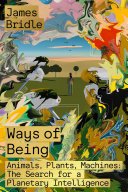
Artist, technologist, and philosopher James Bridleâs Ways of Being is an exploration of different kinds of intelligenceâplant, animal, human, artificialâand how they transform our understanding of humansâ place in the cosmos.
What The Reviewers Say
The Economist
The first step towards an interspecies future, Mr. Bridle argues, is showing more appreciation for other forms of intelligence...To some extent, this is already happening, starting with cephalopods...Through films and other initiatives many people now know that octopuses have an advanced and strange intelligence...Human beings’ last common ancestor with the octopus lived 600m years ago, compared with 16m years for the chimpanzee...Yet the octopus eye resembles the human kind. If similar eyes can evolve through separate routes, so might intelligences...The next step, Mr. Bridle asserts, is recognising that people live in an 'entangled' and 'more than human' world...Everything is messier than it seems...Other intelligences have developed from a common evolutionary base, and they overlap in ways that science is just beginning to discern...Mortal intelligence is not only limited by its capacity, but by its type: people are bipedal primates who see and hear better than they smell and touch..
Stefan Merrill Block,
The New York Time Book Review
Bridle offers a heady and often astonishing survey of recent discoveries from the 'more-than-human' world, where science is only beginning to glimpse the myriad forms that nonhuman intelligence can take.
Brenna Maloney,
The Washington Post
If you plan on reading James Bridle’s Ways of Being — and I cannot recommend highly enough that you do — you might consider forming a support group first. The ideas in this book are so big, so fascinating and yes, so foreign, you are going to need people to talk to about them. Have your people on speed dial, ready to go. And make sure you set aside a good amount of time for reading. You probably won’t be reading this book once. You’ll want to read it several times. This book is going to stretch you.
Richard Lea,
The Wall Street Journal
With habitual insouciance, the writer blurs the distinction between individual and species.




 37
37 97
97